

I am what you might call a mildly handy person. I can do all of the basic, entry level activities in a pinch. Change oil. Hang some drywall. Replace a ceiling fan. Lay some tile.
If pushed into a corner, I can take it a step further. It won't be fast, but I could build you a chair. I once built a giant, way too heavy and solid, climate controlled cabinet in my garage.
The projects are never pretty, but I can do them. I mostly choose not to and hire an expert. I call my plumber. My electrician. My contractor to redo the tile and I will see you in hell if I ever have to do carpet work again in this lifetime.
Those trades rely upon my need for their expertise. The craftspeople who have honed their skills over time to the point of habit I trust to solve my problem. If they tell me I need to replace a part I dig into my wallet.
And yet, we don't do the same thing for other equally hard earned trades. It might be because we have culturally divided the world between honorable work (using your hands) and dishonorable work (using your mind). It's probably wrapped up in the notion of sacrifice and martyrdom that permeates our society. It most certainly goes well beyond the left/right dichotomy.
With honorable work, it is ok, in fact encouraged to call upon experts to aid you when needed. The amateur is dangerous, scorned, and even pitied. Perhaps, if the work is in a related field to their expertise, can the amateur be given a pass for doing their own research.
Conversely, with dishonorable work, experts are to be scorned and ignored in favor of amateur activity. The most extreme examples of this is found in medicine and the sciences. But it doesn't stop there.
A little information is easy to acquire now. It creates a false equivalency between that acquisition and the hard earned knowledge through study, research, and training. An illusion of competency.
Take, for instance, a trade I am more than a little skilled in like graphic design. In my lifetime it has transitioned from a semi-honorable craft to a dishonorable craft. The move from print media to digital media shifted the narrative so much that we are discussing the end of the craft all together with the advent of artificial intelligence.
Don't let anyone fool you with their bullshit. Graphic design is a craft. It is no different than carpentry. You can always tell when a person did the work and a machine spat out garbage.
That is why this weekend's sudden debate on adventure layout design in table top games is a perfect illustration of this honorable/dishonorable work dichotomy in action. A lot of words were written by a lot of amateur graphic designers debating the value of paragraphs vs bulleted lists.
I shit you not.
While reading this and the various discussions about it, the thought that rolled through my head the entire time was, "none of these people are designers."
Designers think about the entire piece when designing. What the work is trying to say. Each page. Each spread. The grid. The type choices. The final output materials. If it is print, the type of ink and paper.
There wasn't much call in the various corners of the internet for leveraging the talents of trained professionals. No one called their cousin who interned with Paula Scher. Just endless words and debate.
This whole situation is like if my mechanic was listening to me and my buddy argue over the go cart kit we built. The thing barely moves. We are overly proud about our bad choices. We like to laud other amateurs who are a bit better than we are and are ignoring him and all of his expertise.
This must be what the science and medical community feels like every day...
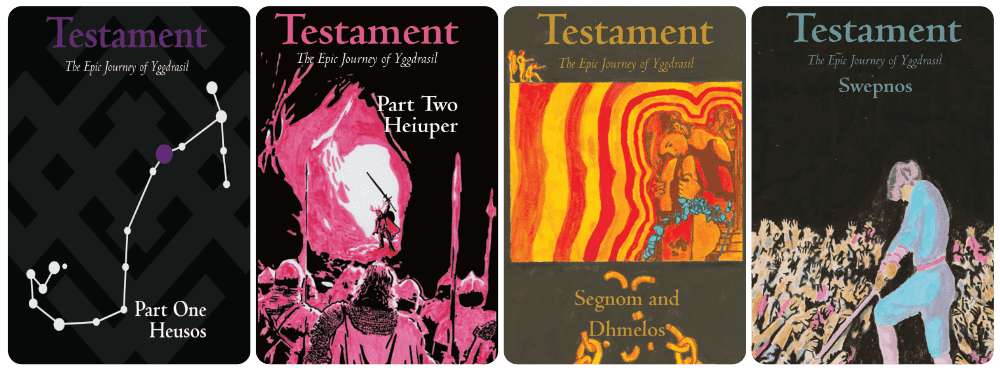
Testament
Testament is a five part epic poem in four volumes that wrestles with the challenges of our now through the mythology of a world that will never be. Within its pages you will find angst and fear, gods and heroes, triumphs and defeats.


