

I have always been kind of fascinated by hex crawls. When I used to run and play Basic/Expert Dungeons & Dragons on the regular, I rarely tapped into them. They were more a neat visual device than a means to play the game. I was probably caught up in the shift that was happening in the 90s. Lots of story driven play and a lot less play drive the story catalysts to games.
By the time I had embraced my preferred, enjoy the unexpected style of play, I had moved on from D&D and her relatives. It is only since I started playing Torchbearer with my kids a few years ago that I got to really explore the value I get out of the "hex crawl" style play.
My new adventure, split across the next three issues of Yggdrasil MGZ, is very much grounded in my approach to hex crawl style play. It is heavily influenced by a few key sources that opened my brain up to specific possibilities...
- Scenic Dunnsmouth is an adventure that uses dice on paper to map out the location as well as randomness regarding the people in this local. It also uses a clever mechanic to set the conditions of the situation with that die roll, allowing for a certain amount of replay-ability.
- Carcosa is a wild setting book whose hex descriptions are sparse but evocative, giving you just enough to shape things for yourself. I played it at a convention and had long discussions afterwards that stuck with me for years.
- The Ghost Tower of Illmyr Fens is the latest Torchbearer adventure from Luke and Thor, which is sparse and tight. From an editorial standpoint, trying to achieve that with this monster has been the goal. I think without it, this issue would be 200 pages alone.
I am getting close to done with the first installment. Bad news is, I can't accomplish my original vision, and as such is running behind. The good news is, this thing sort of cascades. After the first issue covering the Sanctums of the Serpent Vaults, the following issues will only be delayed by the speed in which I can generate the artwork.
Being a one person band is a bitch some days...
What Makes Up a Hex?
This question has bedeviled me for some time. When I think about what goes into a hex, I am very much thinking about what is useful in a hex at the table? What is the right balance of things to transform the material from authorial masturbation into, to continue the metaphor, great fucking sex?
Well, I have learned that it is all about seeds. Some of those seeds need to be "read out loud" bits to act as setting shortcuts. Others need to be on the fly tools for the game master to draw on to connect the dots. The important thing is for it to not stand on its own.
A hex is a cell within an ecosystem, not an ecosystem unto itself. Its relationship to the other hexes around it and the wider region is important. It needs to tap into that, which is why I kept them to two page spreads with a reliance on the other elements within the issue, as you can see in this lightly edited preview...
The Square
A small crowd is gathered in the center of the square before a raised wooden platform that has seen much long use. Throughout the crowd, hawkers shout out their wares while miscreants up to no good weave through, lifting purses. Little can be heard above the din until you work to the edges of the square among the shadow dimmed alleys where an entirely different trade takes place.
The Black Alley
Before you, off the square, sits a warren of twisting paths, strewn with the detritus of centuries. These are not empty alleys, but filled with the kind of commerce that feeds on the desperate for the price of their souls. Information, drugs, and people are all for sale for the right price.
The Platform
At one end of the square the unenthusiastic crowd mills before the wooden scaffolding as one by one poor souls are executed. Behind them are cages crowded with those deemed too dangerous or inconvenient by the Tyrant. But do they deserve their fate?
The Guard Station
At the other end of the square from the platform, a rough structure and barricade stands with soldiers in the livery of the Tyrant eyeing the crowd. These are hard men and woman from the look of them, but they appear nervous. It is as if they are waiting for their doom.
The Witch Market
At the other end of the square from the platform, a rough structure and barricade stands with soldiers in the livery of the Tyrant eyeing the crowd. These are hard men and woman from the look of them, but they appear nervous. It is as if they are waiting for their doom.
The Nest
At the other end of the square from the platform, a rough structure and barricade stands with soldiers in the livery of the Tyrant eyeing the crowd. These are hard men and woman from the look of them, but they appear nervous. It is as if they are waiting for their doom.
Fanim the Fence
At the other end of the square from the platform, a rough structure and barricade stands with soldiers in the livery of the Tyrant eyeing the crowd. These are hard men and woman from the look of them, but they appear nervous. It is as if they are waiting for their doom.
D66 Encounters
11. A victim being mugged
12. Enromous rats devouring a corpse
13. A drug dealer’s crew doing business
14. A wererat pack leaps out from the shadows and demands a conversation...
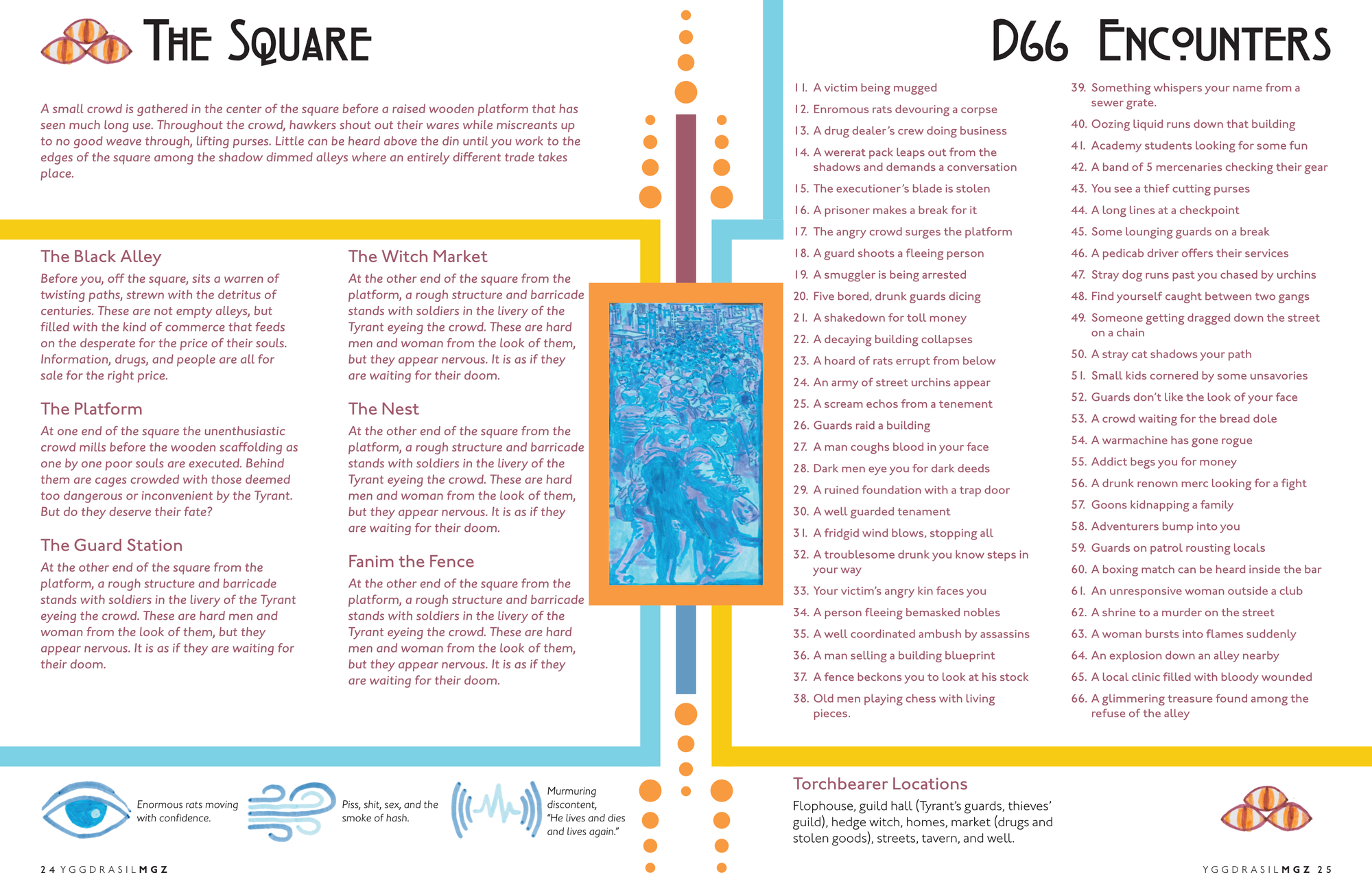
The hex itself is a neighborhood in the Shifting City. On the left you see an overall description as well as several location descriptions for this hex. All of these are intended to be read out loud to the table when entering these spaces.
There is also three sensory nodes at the bottom. I have found that games and gamers tend to forget to evoke all the senses in play. These are intended as a guide for the game master to tap into multiple senses when describing the environment.
On the right hand side the hex has a D66 random encounter table. Unlike the Twists and Encounters table earlier in the issue, these are tailored to the hex specifically. They provide local color, and are sparse, but directive to allow the people at the table to easily shape their own version of the square.
Two other items of note are the Torchbearer Locations call out, and the three eye icons. These are examples of how the hex needs to rely upon the rest of the material.
The locations are specific to the Town Phase rules and to how I use them in cities. A city is really multiple towns, with each neighborhood having its own infrastructure, so what is available when entering "town" here has to be clearly articulated. It also functions as a guide for using the hex crawl with Basic/Expert D&D.
The eye icons are tied to the faction rules for the hex crawl and how they influence play. When I can, I try to use visual indicators as much as possible to key material in my work. This is the lightest, but most obvious of examples.
Everything in my game design work is centered around play at the table. The size of the documents, the layout, the art and how much I choose to use are all chosen to support that. The unattainable goal is to make the material striking enough to get people to want to engage, but fade into the background as play proceeds.
Only you all will be able to tell me if that is true. Creator bias is a very real thing...
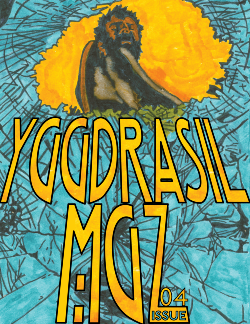
Issue Four
The fourth issue of Yggdrasil MGZ is one massive adventure for the Torchbearer RPG. Imagine if Die Hard was set in the tower headquarters of necromantic zealots standing on the grave of an ancient evil and you are John McClain!


