

When I first began working on this mega dungeon project, I knew that I wanted to create something that had an evergreen quality to it. In principle, I wanted folks to be able to replay it and get a different experience. I am also an advocate of emergent experiences in gaming, and so didn't want to create something that was overly prescriptive or planned out.
I also knew I wanted to have an "urban crawl" in the middle of my dungeon. I have fond memories of Tom Moldvay's The Lost City and wanted to evoke some of that feeling. However, urban crawls can be tricky if you don't have enough tools available to build things on the fly.
Out of wrestling with these two demands I have put upon myself grew the Shifting City. I fell in love with the idea that it would move and change every time you came back to it, creating new opportunities for play. The trick was to try and figure out how to make it work.
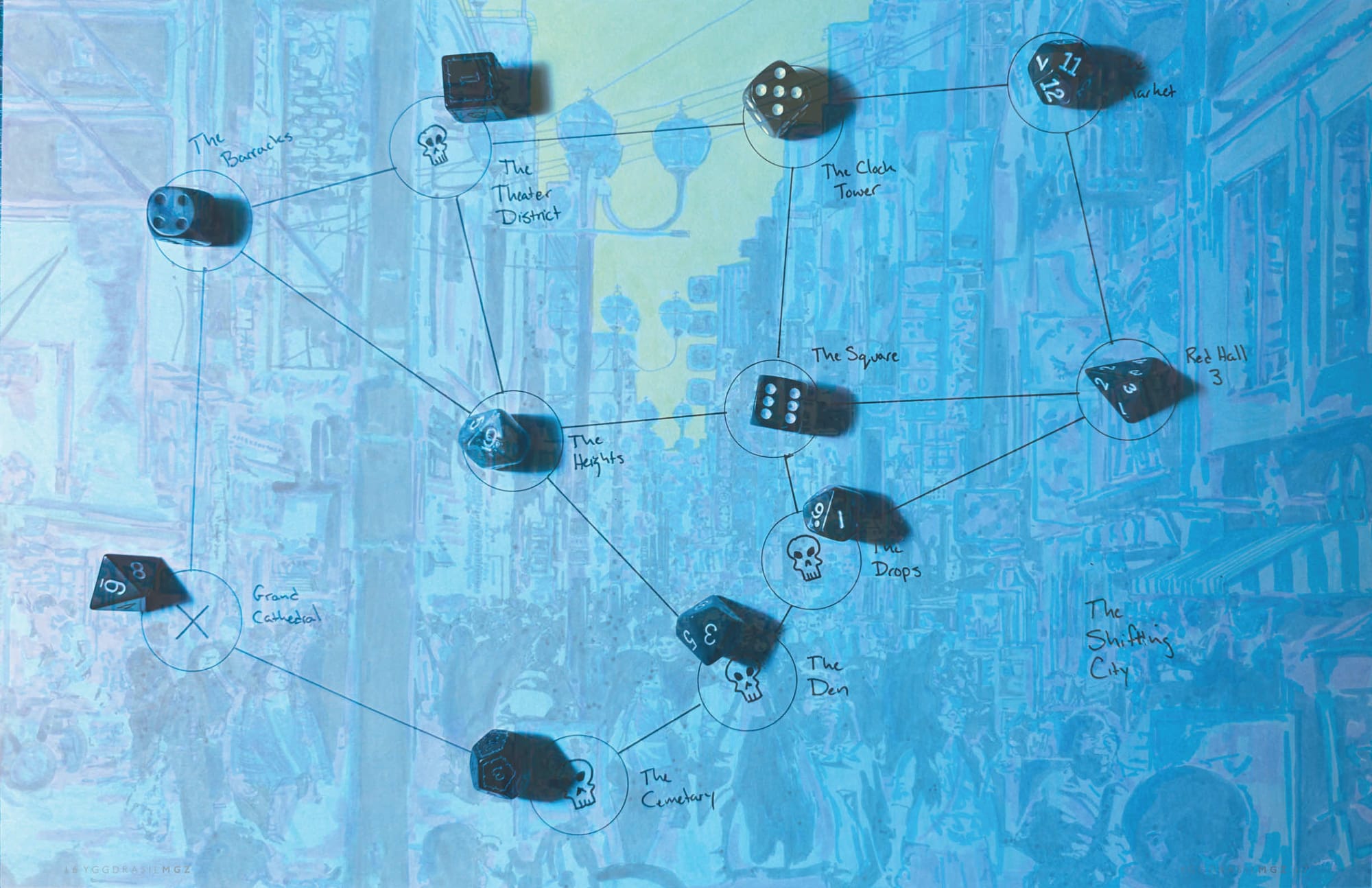
Ultimately I settled on throwing dice onto some paper and seeing what happens...
The Shifting City
The Shifting City is a maze of ramshackle neighborhoods strung together with all manner of detritus. Metal roofs, bone walls, tents, caves, bricks of clay, there is no material not in use here. Smoke fills the air and dims the light of the God’s Eye.
The inhabitants are all under the sway of the three gangs that rule the streets. The God’s Venom, the God’s Joy, and the God’s Wake fight constantly for advantage. There is no trust. There is no safety. There is only the hope for a quick death when it comes.
How to Set Up the City
There is no set structure to the city. Each die your rolled in this stage represents a neighborhood. Follow these instructions every time the adventurers enter the city.
First you need tools. Collect a large sheet of paper, a piecce of paper to capture notes, a pencil, a D4, a D8, 4D6, 3D10, and 2D12. Each of the D6, D10, and D12 should be a different color.
- Roll the dice onto the sheet of paper.
- Draw a circle around each die.
- Draw at least two lines from each dies location. This is how you move from neighborhood to neighborhood.
- Find the the location of the D4. Next to it write Red Hall and the number you rolled in the circle. This is your entrance from above.
- Find the location of the D8. Next to it write Grand Cathedral. If the number rolled is less than or equal to the value of the D4, draw a skull in the circle.
- Find each of the D6s. Pick one and write The Square and next to the others write one of the following; The Clock Tower, The Theater District, The Barracks. If the number rolled is less than or equal to the value of the D4, draw a skull in the circle.
- Find each of the D10s. Pick one and write The Drops and next to the others write one of the following; The Clock, The Den, The Heights. If the number rolled is less than or equal to the value of the D4, draw a skull in the circle.
- Find each of the D12s. Pick one and write The Market and next to the other write The Cemetary. If the number rolled is less than or equal to the value of the D4, draw a skull in the circle.
- Mark the location of the die furthest from the Serpent’s Maw with an X. This neighborhood holds the entrance to the Dream Way.
- Every neighborhood with the skull is under the influence of the Necrolord.
The Neighborhood
Each neighborhood has a description and a faction icon. The description is intended to be read outloud, and the faction icon represents who holds power there. Any action the players take in that neighborhood impact that faction unless the Necrolord has taken hold.
Each neighborhood has several locations highlighted that function as starting points with additional text to be read aloud. They also have a random encounters table for to roll or pick from for your ad hoc adventuring needs.
Lastly, in Torchbearer terms, the Shifting City is a Forgotten Temple Complex for entering the Town Phase. The neighborhoods are their own Town and lists the available services.
The Necrolord’s Influence
The power of the Necrolord is rising. They have made their first move and are consolidating their control. They seek to remake the city in their image.
For each neighborhood you marked with a skull, swap the faction icon with that of the Necrolord. No matter who the party encounters in that neighborhood, they are working in the interest of the Necrolord now.
Sometimes the Necrolord’s influence is more overt. In those circumstances, change the encounter type to use the undead and necromancers at your discretion. You can do this by swapping out for the undead or by keeping existing stats and changing their description.
Traveling the City
Navigating the Shifting City is a daunting task, even for the natives. The locations of neighborhoods shift and slide regularly. What is a short cut one day may lead into a blind alley the next.
To add to the difficulty, the city is crowded. If you have never been, look up a video of the crossing at Shibuya Station in Tokyo. That is what I mean when I say crowded.
The streets are choked with people. Conventional approaches to going from one neighborhood to another is slow going and unconventional pathes are dangerous.
If you are playing Torchbearer, moving from neighborhood to neighborhood requires a Pathfinder test (DH, page 168). When determining factors, the Destination is equal to the number of lines on the maps used to get from one point to another.
If you are playing D&D use the Woods modifiers when determining success navigating the city. The Game Master should make the 1D6 roll for determining if the party is lost for each line of travel between neighborhoods they use.
Issue Four
The fourth issue of Yggdrasil MGZ is one massive adventure for the Torchbearer RPG. Imagine if Die Hard was set in the tower headquarters of necromantic zealots standing on the grave of an ancient evil and you are John McClain!


