

I gotta admit, sitting on this AI bubble has reignited my obsession with economics. Well, not so much economics as the history of economics in the United States. The boom and bust cycle. The creation of the Federal Reserve. And of course, the crash of 1929.
If you spend any time studying this history, you run across the idea of moral hazard. If you are unfamiliar with the term, the idea is simple. An economic actor has an incentive to increase their exposure to risk because they will not bear the full cost associated with the risk.
The term is big in the insurance industry and came back to the foreground with the Great Recession. However, I have been thinking about it a little differently. What if moral hazard was a core mechanical element of a game?
Welcome to my thought experiment...
Let’s take a game everyone is familiar with, Dungeons & Dragons. In D&D, when I roll dice, the hazard is born by me, the player. I declare an action, and my character, which is simply an extension of the self, carries the risk. There is, of course, some nebulous collective risk to the party, but a party isn’t a union and I can make a new character.
This risk/reward matrix is effectively mine alone to bear. If I open that door or attack that bugbear in that way, I reap the reward or the consequence. However, what happens if I am unaware of who eats the consequence.
That is the key to moral hazard. The party that absorbs the consequences is abstracted from the perpetrator of the action in the moment. So what would that look like in D&D?
The core mechanic of D&D is the combat mechanic. The slow attrition of hit points over time balanced against the accumulation of wealth. How much you choose to push this is tied to effectiveness, but if it wasn’t, how would that work?
Would it mean that you endanger the town you have a vested interest in back home? Would your lost hit points mean children get polio in the capital of the kingdom you call home? Would it mean that people die in the next kingdom over?
Would you do anything different as a player if you knew someone abstracted from you carries the burden of your decisions?
Roleplaying games like to enforce the illusion of personal agency to change the world. It is the hero fantasy we have been carrying in the US and Europe since Arrian wrote the Anabasis. Of course, the world doesn’t work that way. Others more often pay for our choices than we do.
With all the games out there attempting to “capture experience” I’ve yet to see one capture how often we make choices that hurt others no where near the choices we make...
Weekly Roundup
A finalized cover, words as mechanics, shoes are now AI, and the best hockey ever filmed.
My Work
I always liked the White Wolf splat books in theory. The idea that players got something specifically for them to help them make the character they want to play is just appealing to me. Unfortunately, other than the wonderful art, they always fell short of the promise. I think that is why I am so hell bent on trying to make good ones for the Mystery Box.
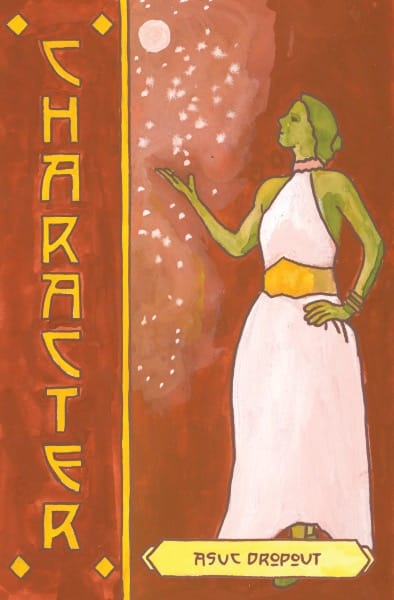
Below you can see the cover design for one of classes, the Asuc Dropout. I decided that all of the books, all of the designs, will have a painterly quality to them. I find myself steadily bored with slick, computer assisted art, and graphic design. It is all so sterile and lacking heart.
Gaming
I am intrigued by the idea of Realis as gaming technology. The setting and art isn’t my bag, but the idea of language as system is something I personally toyed with in 2005, so seeing someone really work it into reality is nice to see. You can check out the Kickstarter to learn more about it. Link
Technology
I have this distinct memory of every company suddenly becoming a .com company just before everything went to shit. It was slowly, then all at once, companies that had a normal business model went under after they went all in on something they didn’t understand. Enter Allbirds and their pivot to AI. If that isn’t a sign of something, I don’t know what is. Link
Creativity
I finally got around to catching up on the most recent season of Shoresy and I am struck once again on how interesting the cinematography and directing of the show is. The show rightfully gets accolades for its writing and acting, which is sharp as hell, but the way it is shot is really under the radar. There is a really interesting interview with one of the cinematographers over on Zeiss that is worth a read. Link


