
I have wrestled with my art ever since I was thirteen. That is the age of self awareness. The timeframe when your peers judge you on new, unclear criteria. The moment in life when you begin to judge yourself with an adult's metrics, but without the understanding of those metrics.
Am I good enough? Is my art any good? Why is their work so much better than mine? Why is this so hard? What is broken in me?
Those are a lot of shitty questions to ask yourself. There is no way around that. They swirl around me like ghosts. They rattle chains and whisper in my ear. As I got older, I learned to ignore them. Most of the time.
These days they mostly just look over my shoulder and make inarticulate noises of disappointment. But back then they were always eating at me. Their voices were loud and insistent.
Two years later, wrapped in my haunts, I turned fifteen and I got two gifts. My best friend bought me Mao's Little Red Book. My brother got me The Communist Manifesto. They thought they were funny.
Turns out that these joke gifts had unintended consequences. Back then, my best friend was a libertarian. My brother still leans that way. I was clearly going in another direction, so they thought it would be funny.
You got to remember, communism was still big E evil back then. We were, as my grandmother used to call it, Kennedy Democrats. So you hate communism and try to pretend the things you fight for isn't a form of socialism, because again, big E evil.
We carried a lot of illusions with us then. Many of us still do...
But, I guess it was funny back then. In that ironic sort of way. Not that they had an ironic bone in their teenage bodies at the time. No, they unintentionally gave me a framework for my nascent thoughts on empathy, the state, and society. But they also gave me another ghost. One that I have never been able to ignore. One that whispers...
Does this art have meaning? Does it have any value to society? Don't you have anything to say? Why is it so shallow? Why isn't it political?
There is that word. That dirty, angry word. The word used to dismiss and distort. The word used to describe the moving speeches of giants that sit alongside the most vile and racist speeches of monsters. A word that means everything and nothing at once.
Political. Politics. The words no one seems to understand...
In 2019, Lin-Manuel Miranda wrote an op ed titled, The Role of the Artist in the Age of Trump. It opened with a banger...
"All art is political. In tense, fractious times—like our current moment—all art is political. But even during those times when politics and the future of our country itself are not the source of constant worry and anxiety, art is still political. Art lives in the world, and we exist in the world, and we cannot create honest work about the world in which we live without reflecting it. If the work tells the truth, it will live on."
When it came out, there was some debate in the spaces I occupied. Semantic quibbles about the meaning of the words. Straw man arguments about pop culture art. It was a blip that bothered me some, but not enough to do much in the middle of my demanding life.
I had suppressed the voices. Work, family, relationships all carry a weight. That weight can make it easy to fall into a sort of autopilot. A separation from your self in service of others.
Some find it freeing. Others oppressive. At the time, I didn't know which it was.
Then March rolled around and we went into lockdown. I was no longer traveling every week. Somehow, my work day got longer, as my role became global. I became trapped with myself in a long neglected art studio having video calls about things I didn't care about.
Cracks started to show, and the ghosts started to sneak in...
Then, in May, George Floyd's murder by police catalyzed a wave of protests. At the same time, layoffs started to become a real thing at work. Also job offers from other places. I began to consider a change.
Amidst all that I painted these two pieces.
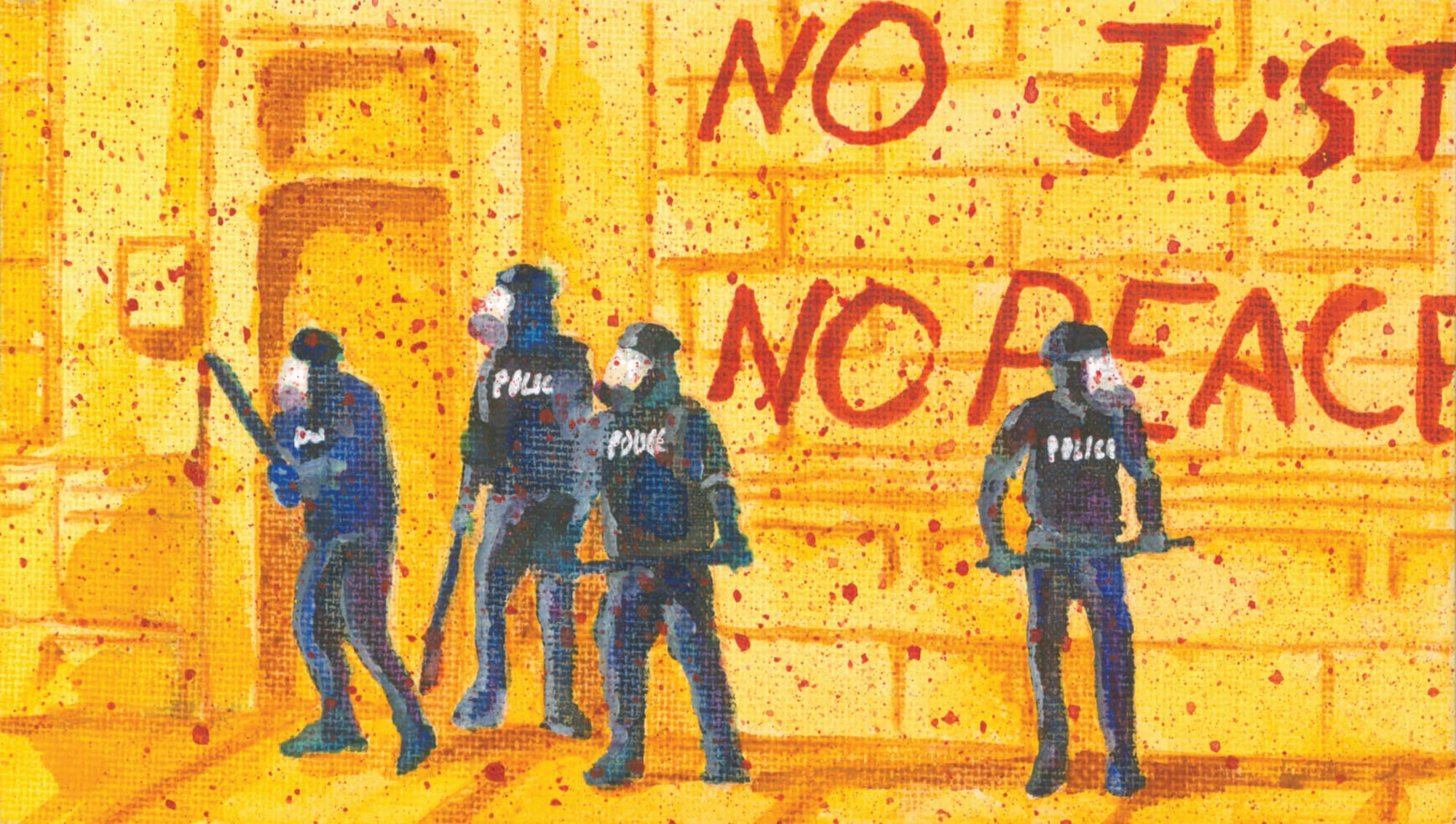
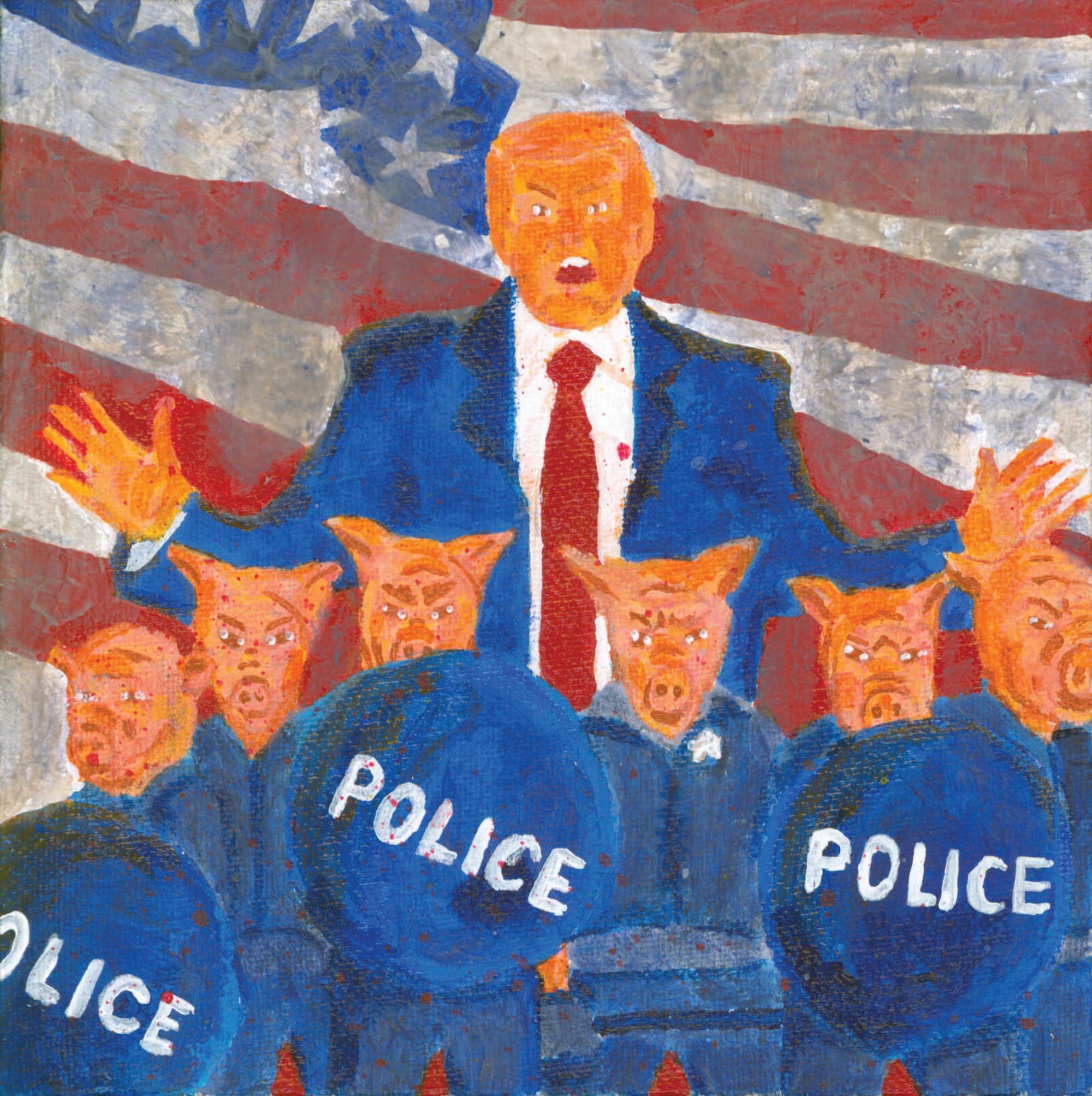
They were and are still the most overtly political art I have ever done. They just hit you over the head with their message. I hated how it felt to make them. I hate to look at them.
And because of them, those ghosts I mentioned before got stronger. The crack became a door and they flooded into my space, adding a new question...
Why do you waste your time with this other obsession?
That other obsession being my book and all the pieces of art I surround it with. A sea of paintings, illustrations, linoblock prints, notebooks of ideas, poems, and snippets of more books shoved into corners of my studio. All of it art, none of it seemed to meet Lin-Manuel Miranda's definition.
That shit bothered me. It bothered me a lot...
We use the word politics derisively in the United States. It is a means to demean the worthy ideas of others. We say shit like, "shut up and play" to athletes. In casual conversation we encourage people to keep politics "out of it." Anything our collective, white cis driven society doesn't want to confront gets dumped into that bin of politics so it can be safely ignored.
When reflecting on this avoidance mechanism, it stirs up all the anger I have spent a lifetime trying to manage. I want to scream out that, "politics is just how you make decisions as a society so everything is fucking politics!"
Not exactly helpful, but would sure feel good to scream at someone...
And so the ghosts continued to haunt me until they got quieter with Biden's win. Then they started screaming at me as I watched an attempted coup happen, shattering any leftover illusions I may have had about my country. Those cold war driven ideas of "the greatest democracy in history" were completely gone.
With that shattering came self reflection. If I accept Lin-Manuel Miranda's statement that "All art is political" as true, can I find the politics in it? When I really look at it hard and reflect on it, what will I find?
Too much of a coward to look at my own art, I looked at something easier for me to examine... Table top role playing games. They have been a cornerstone of my creative life for so long I barely remember not having them as a catalyst for creativity.
I decided to start with three games. It seemed right to pick up Torchbearer, Gygax era D&D, and 5E D&D, to see what I could find. Some may argue they aren't art. I disagree.
When I examined them with this lens, I poked at what kind of message playing the rules delivered. Not the illustrations that litter the rule books or the quality of the layout, but how do the systems force an exploration of ideas and ideals.
Do they comment on politics?
In Gygax's D&D, we see the eugenics meritocracy at its core sit front and center in the text. Men are stronger than women. Your race is a determinant of your value in the game. And in play, money equals value which allows for progression. It embraces naked, Randian philosophies, which probably explains the innate conservatism in the community.
At some point I need to explore that little nugget of thought, but not today...
In 5E D&D, we see the corporate sanitation of Tumblr. It tries to say all the right things so hard that it ends up saying nothing. It is a voiceless mess of options, trying to be everything, and so becomes nothing. As a result, the play itself doesn't surface any more than the corporatism of the last ten years.
It is the politics of Arasaka in Cyberpunk 2077 or Carlyle in Lazarus...
In Torchbearer, we see a clear criticism of libertarianism throughout the text. It frames up the old idea of the self made person and makes it the central story. On its surface, it appears no different than Gygaxian D&D, but play subverts this idea entirely. Success of the downtrodden only occurs through collective action and cooperation.
No wonder it is my favorite game...
I probably could have kept going in examining different works of art. I am a member of the Art Institute, and could have spent days just relooking at the collections through this lens.
But I have done that already dozens of times. Maybe every time, consciously and unconsciously as I wandered through the galleries. I needed to eat my own dog food and look at myself and my work.
I guess I needed to look outward before I could look inward. It became easy to see the threads of politics in my work this time. There is always a message in there. There is always a shadow-self I am wrestling with. There is always that thread going back to that fifteen year old kid.
Which, to get to my point, is that yes, all art is political. The politics lives in the art. It is chained to the person who created it. The time they lived in.
Sometimes it is subtle, hiding under the surface to be found. Other times, it comes out and hits you in the face. Either way, I think culturally we need to spend more time looking at art through this lens. To ask questions about the work and the artist, and in some cases, the publishers.
I think if we do, we can move away from this desert we have found ourselves in. A desert of authoritarian conformity and a demand that we "keep politics out of it."


