
The past few weeks I have spent a stupid amount of time investigating artist alley table approaches. I noted people’s design choices at C2E2, particularly if they seemed to be doing brisk business. I also watched a lot of YouTube videos.
Too many videos. Way too many...
There is a lot of advice out there. Most of it centers on the anime focused fanart world. Stickers and keychains and mini-prints all over the place. It’s all about cubes and shelves and attracting an audience that my work does not appeal to.
Hours and hours of videos of content. Internet detritous surrounding the occasional gem like an artist recording how they set up their table. I also stumbled on Inkwell’s channel covering his life as a full time convention artist.
Took some sifting, but there is still interesting things to be found.
One video that pulled me in, Social Media is a Trap for Artists? is actually at fault for the wilderness I find myself wandering in. Not because of the main topic. No. That would be too straightforward.
No, my brain latched onto an offhand comment about pitching.
In particular, they mentioned talking to people at shows. They were comparing a proxy selling for them versus how they do things. Interesting, but I tuned them out at that point. The horses had left the barn.
As my brain. Or horses. Or whatever wandered off, thoughts about pitching and selling artwork in this current environment began to coalesce. As I see it, there are five important social structures at play even before we talk about the talent of artists.
- Computers, but more importantly the advent of the internet, has rewired our society for ever tighter classifications. Everything must have the right label and be in the right box.
- The internet has become Facebook. Everything is a series of walled city-states that require citizenship to access, creating barriers to the discovery of niche communities, if those communities still even exist.
- There has been a lot written about the global conservative shift in society. One aspect of that rarely gets covered is our endless obsession with conserving the past. It permeates movies, books, social media content… honestly everything.
- Cheap goods and tech industry driven innovations over the decades have shaped consumer habits and pricing expectations. It has spawned an attitude of entitlement and dismissal of the value human craftsmanship.
- Art takes up space in a way other purchases don't. It creates an unseen influence upon the market that unintentionally impacts how competition between artists plays out.
Into that world, that social fabric, is where an artist has to make their pitch to customers. Be it online or in person, with these forces they must contend. This is all before all the other barriers to capturing an audience’s attention show up. Before even considering skill, subject matter, and market fit, these structures are fighting against you.
It’s a lot to contend with.
Now, if you are tapping into the mass market with 5x7 mini prints of whatever the hottest fandom is, you are playing a straight commodities game. That is not what I am talking about at all when thinking about how to pitch art. Pokemon does alright on its own.
I’m talking about an artist pushing their own work. Their own style.
In my life I have worked in marketing and I have pitched work to clients. I was good at it. I was really good at it when I had a hook. I was amazing at it when I had a hook and a team of brilliant people to pitch with.
But, in that case, you got to operate at a remove. You weren’t trying to explain to someone the value of your emotions, ideas, and soul manifested in physical form. You were selling a solution to a problem. You were anticipating how they would push back or disagree with your solution.
It was a game with high stakes. It was like poker. It was stressful, alluring, and winning was so sweet. You had to read every moment and sell yourself as an answer to their problem.
Answering a question is always easier than selling an idea.
That got me thinking. What if instead of trying to describe my art as a pitch, I described the question it answers? Would that even work?
Probably? Maybe? I’m not so sure.
I am forgetting something important. Every client was different, so every question you answered was different. Even if the work was similar.
Another wrinkle with this idea is that for myself, I do a lot of different types of art. I make game stuff. I write and publish poetry and fiction. Comics. Paintings. Prints. Woodworking is joining the list soon.
Basically anything that captures my interest on any given day. All of those things are going to need different versions of the pitch. Some will be easier and some will be harder.
And I still haven’t addressed value in any of this. I’m not even sure that is possible at this point. Value is so skewed in strange ways societally, I’m not sure that art can even slot into the conversation outside the collector, tax shelter level.
I’ve watched people spend ungodly amounts of money on plastic crap in a box, but balk at a beautiful game book costing $25 dollars. I’ve seen people try to haggle with artists over handmade work that clearly took hours to make. They dismissively see only the materials and not the labor that made it possible.
All of this is to say, I don’t know if there is a great answer on how to pitch to customers. The market reflects the same forces as the environment of business, but the item for sale isn’t a product in the same sense of the word. Art is in conflict with the very thing that makes the ability to create it possible.
Commerce.
Like with most things, the only answers that can be found are through doing the thing. So I am going to try and do the thing. Maybe it will work. Maybe it won’t.
All I can do is start trying to answer some questions.
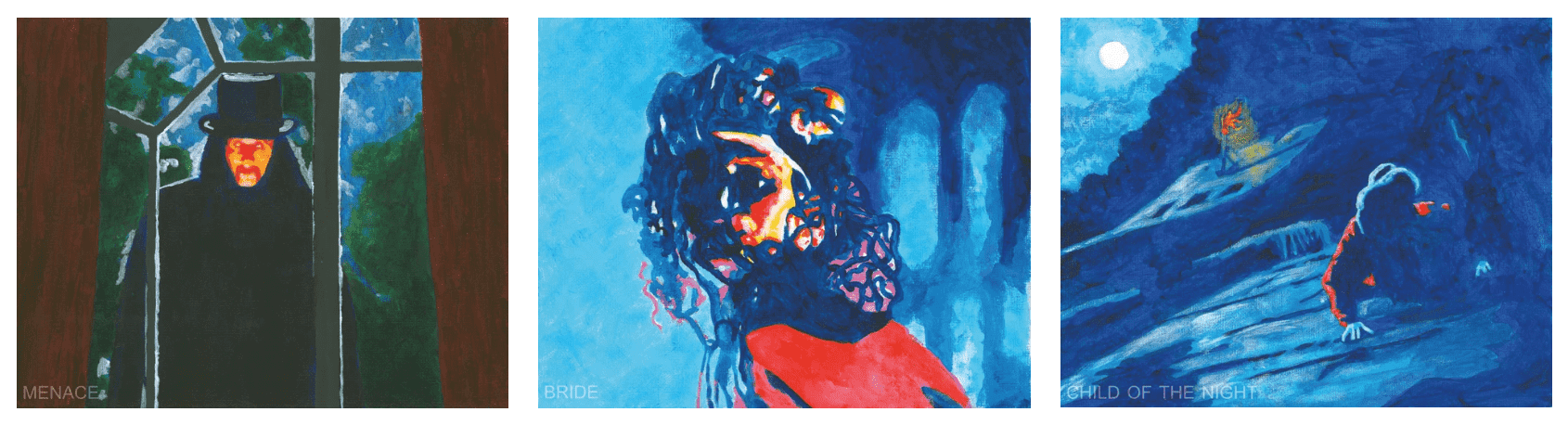
Original Artwork
I have a whole lot of original artwork available for sale on my website with new pieces going up for sale all the time. Right now I am featuring a series of 8x10 acrylic paintings of scenes from Bram Stoker’s Dracula. They make a great gift for that emo kid in your life.
Weekly Roundup
Convention tabling, product design, AI as a cover for incompetence, and a bold way to test your artistic talents.


