
Strahd has been on my mind lately. It is a strange thing to say, but it is true.
It might be that we are nearing Halloween. I have ramped my annual binge of weird and gothic films. I'm less a horror guy and more a macabre guy. I like to be unnerved more than fleeing in terror.
Real life is terrifying enough.
So the old boy has been on my mind lately. In particular, I have been thinking about hosting the myth of him has changed over time. The version I encountered in the 90's is very different that the version found in Expedition to Castle Ravenloft, and even more so than the version in the recent board game or Curse of Strahd.
He has had many an unlife, Mr. I am the Land, so I wanted to poke at his origins a bit. Take a look at that very first adventure from 1983. I haven't played or even looked at it in over a decade, so now seems like the right time to do it...
A Tangible Object
I am lucky enough to have an original copy of the adventure in my possession. I picked it up for a song when I first discovered Ravenloft in the 90's. This was before people suddenly realized that these things had value. My copy is in really good shape too, all things considered.
That striking cover of Clyde Caldwell still sings, and the isometric maps of the castle are still just perfect. The map of Barovia is basically just the map for Castle Dracula and the village with the inn near the crossroads that Harker stops at in Dracula. And the damn thing is only 32 total pages!
I mean, these days, most adventures for that hoary old goat, Dungeons & Dragons, are what? Well over a hundred pages right? Even most of the OSR hack stuff I have seen or the DCC stuff is pretty lengthy despite the harkening to the past.
And to be clear, this is 32 pages with several, full or half page Clyde Caldwell illustrations. A lot of artists get way more love than Clyde from this era, but he and Stephan Fabian defined fantasy art as far as I am concerned. Clyde brought the moody color of Hammer Horror while Stephan gave us unnerving black and white gothic storytelling.
Both are huge influences on me as an artist to this day. You can see them poking out in my color and black and white work...
Thirty-Two Pages!
I got to talk about this some more. The very first page of this adventure has an introduction and the table of contents jammed together in two columns with solid, workman trade dress. It isn't magic, but it doesn't feel cluttered or hard to read. It also imparts some key information that you pick up at a glance.
- The adventure level is for only 5 - 7, which isn't really all that high when you think about it.
- It is labeled a gothic horror story, which is just weird for an adventure module in 1983
- The table of contents lists details on how to play the villain and optional endings, which is also strange for 1983
And when you turn the page, you dive right into it. You get the standard up front bullshit about balanced parties and everyone will get a chance to do something. There is also the call out that there must be a fighter that can use a longsword (Sunsword!). Also, read this whole thing before you play DM...
Man, I never read a single adventure all the way through as a kid. Not once. Never before play. What kind of fun is that?
Then things get interesting though. Some areas are describes as being straight duplicates, which helps keep the page count down. Smart.
Then we get the end state too. Basically, the game isn't over until the Dracula sings... or Strahd is dead. It turns the adventure into a sort of board game with a finite goal, which is novel for this moment in history. It also references an optional ending on page 30, which is just a block of text to read out loud that ties the fiction up around Strahd and his lady love.
The Vampire, The Myth, The Legend
Strahd's unique character pops off almost immediately, and I can see why in 1983 this was such a big deal. The adventure clearly states, play this dude like a character. He is a vampire, but he is also a 10th level mage with a shit ton of spells. Oh, and he is basically a genius and here are some tactics you can use to illustrate that shit.
Effectively, the Hickmans gave Strahd a set of baseline character traits and instincts. Then you get to flesh out his goals on the next two pages with the tarot card bit. It is smart and what I do with all of my games and adventures rather than setting up any kind of story.
Create interesting characters in opposition to one another with their own motivations. They are at a point of tension, but equilibrium before the party walks in the door. Then all hell breaks loose based on the party's actions and I never have to plan shit. No story writing nonsense, just emergent fun.
But I digress...
Do We Need This?
Seriously? Do we need this tarot nonsense? I mean, I guess the whole gypsy thing was kinda acceptable at the time and a part of the vampire narrative. It creates some randomness to where things are at, but does that matter?
How often are people going to replay Ravenloft?
Also, having the goals be random? Also, when you read them, the authors clearly put more thought into some than they did in others. "Strahd wants the Sunsword" is clearly there to fill things out compared to "Strahd seeks a new identity."
It is one of those things that I think was an interesting idea, but as an editor, I would have probably cut the randomness on the goals part and made the authors flesh out one goal fully. Give Strahd meat.
It is like ten years too soon, but I want "I've crossed oceans of time to find you."
Make the goal about Ireena and love and pathos. Make it tragic and litter the adventure with things that make you feel empathy for the thing you have to kill...
Welcome to Barovia
I cannot promise I won't stop complaining about how this adventure has nothing to do with gothic horror stories. It is a bone I have to pick with Ravenloft since the 90's. It is like my various bones to pick with other games that have claimed literary or cultural importance–cough–Vampire–cough.
Now though, we get into the meat of things, sort of. We get the one column overview of Barovia, some random encounter tables, then a bunch of planned encounters in this postage stamp of a country. Honestly, the whole thing is just to shepherd the party into the grinder that is the castle. You get a little flavor, maybe a little fight, then your fortune read before being sent off to face the "devil Strahd."
Personally, this is why I prefer the Torchbearer approach to adventures. When in doubt, just start at the opening of the dungeon or whatever. Very little of this is necessary beyond the letter, which could easily be adjusted to be tighter hook. It is just a long drawn out version of the "we meet at an inn" bullshit we have all sat through.
Welcome to my house. Enter freely. Go safely, and leave something of the happiness you bring!
God, I love that lie from Dracula. But here we are, the Castle Ravenloft. And the random encounter tables that I need to stop for a minute on.
Everything on this list makes sense between these two tables except for one monster... The Rust monsters. What the hell are they doing here? Everything else is so perfectly placed to be in a gothic vampire story and then, one to two of those things?
Did they run out of ideas?
It isn't the only time that strange shit like that occurs and the adventure reminds you that it is still a dungeon crawl. The four red dragons just hanging out in the entry hall for example have bugged me for years...
Why?
Make them, I don't know, gargoyles... Make it a crazy trap that locks you in like they basically do in every movie...
Instead it is 4 red dragons with 9 HD, but only 18 HP. Someone make it make sense for me.
Another weird D&D-ism that always amuses me is that in any location where there is armor, like in the guest hall, there is always a percentage chance if it will fit. You absolutely know that was written in as a response to someone's played experience. Unnecessary and kind of funny.
Most of the rooms in the castle are empty, relying upon the random encounter table, but it is broken up by a few memorable characters. Lief Lipseige the accountant is an amusing one. He has a simple motivation of being annoyed with his boss for not sharing all the receipts.
I love a disgruntled employee in an adventure. It is weird in a gothic horror story, but as I said, this adventure is not reflective of what is on the tin really. Also, this clown can tell the party where to find a powerful tool to use against his boss. Why Strahd keeps a holy item that can hurt him in his house is beyond me...
Room after room is like this. It is either empty, has some slightly odd character that is likely a trap or hinderance, or a monster. Because most everyone knows about vampires and Dracula, unless your fortune placed one of the useful objects upstairs, a party is likely to head downstairs first chance it gets to get their pay day.
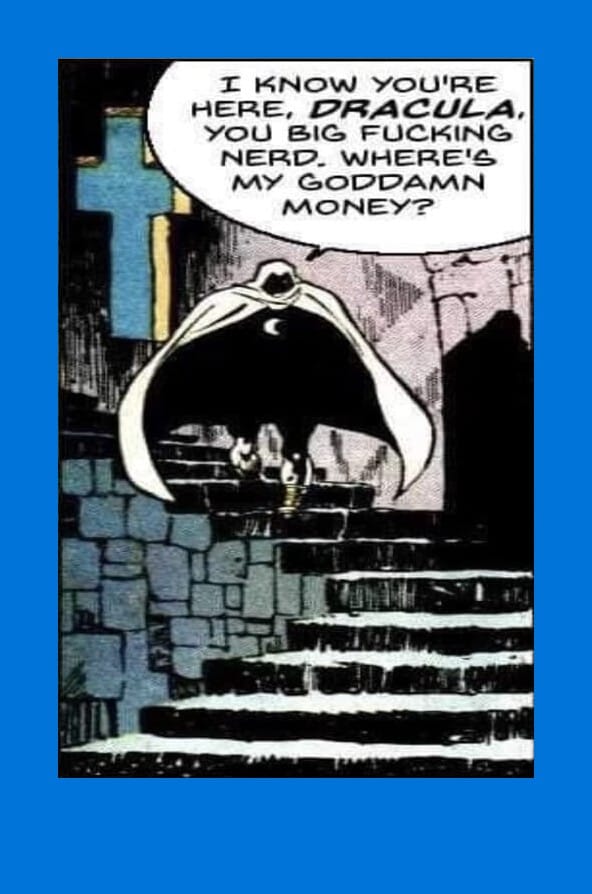
I know that every time I ever played this adventure, as DM or player, that is basically what happened. The castle is honestly huge and I don't think anything game I have ever been in has ever gone to the spires and encounter the witches who are hanging out there.
Wrapping Up
The back of the book gives us the artifacts and a few monsters. The super holy symbol and the sunsword are the great equalizer, particularly if you don't have 8 people in your party rolling with their own super kit of stuff. The Tome of Strahd is some nice color text, but I have always been disappointed it didn't also come with some mechanical benefit.
Like, cool. I know his story. But you landed me in this RPG that is playing like a board game. Shouldn't this shit give me a +1 on my punch him in the face rolls or something?
Of the three monsters at the back of the adventure, two of them are unnecessary. The townsfolk and gypsies are statistically just dudes. You get some color text, but it isn't much different from what shows up elsewhere in the text. It is a sort of wasted opportunity for the "Devil Strahd" to have some more meatier minions.
The third though is my favorite critter in the adventure. Strahd Zombies are an absolute pain in the ass to fight. They turn like mummies and break up and the limbs keep fighting you. The dude sure knows how to be a prick.
What Have I Done?
Good lord, I just wrote 2,000 words on Ravenloft. And, I think I want to do some more of this... I am not sure this is healthy, but I think I am going to write a few more of these rereads of Ravenloft related books for a bit. Apparently I have demons to exorcise still.
Hopefully you can forgive me this trespass...


